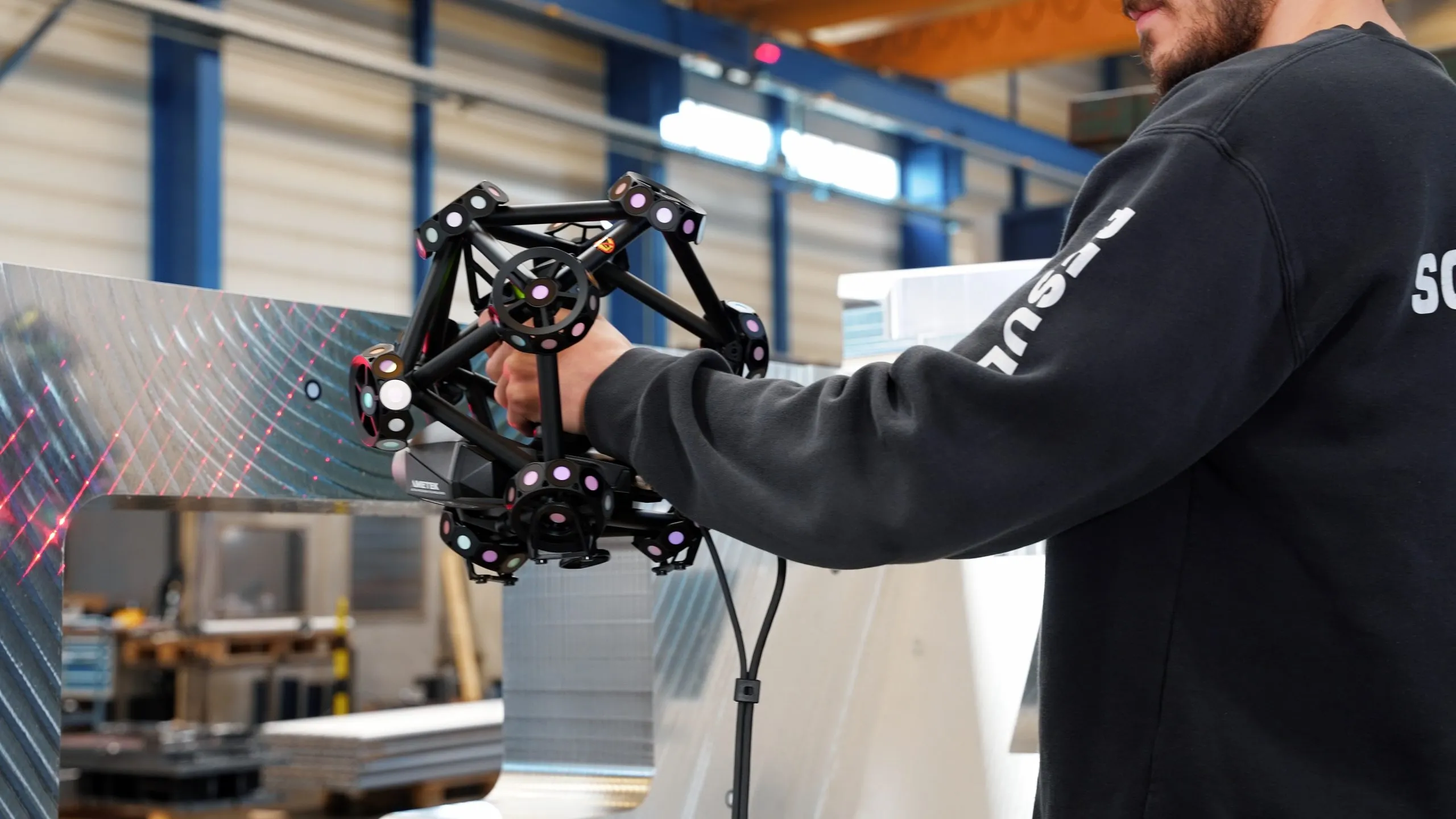
Testing Services Tailored to Your Needs
Our methods and procedures reflect the latest state of the art. Our services range from incoming and outgoing inspections and dimensional checks to production-integrated quality assurance and specialized testing procedures.
We perform conventional non-destructive testing in accordance with current technical standards, either at our testing center or directly at your site.
Testing Methods
-
Radiographic Testing [RT]
A large radiographic testing bunker is available at our facility. On site, radiographic testing is only possible in shielded areas on parts that are not installed.
-
Ultrasonic Testing [UT]
Using advanced equipment, we can inspect your components directly on site.
-
Penetrant and Magnetic Particle Testing [PT / MT]
We use electromagnetic testing equipment with direct and alternating current, including a test bench and yoke magnet. A custom-designed system is available for penetrant testing of high-volume parts.
-
Visual Testing [VT]
Data from the endoscope can be saved directly to a laptop.
-
Leak Testing / Helium Leak Test [LT]
We perform helium leak testing both at our facility and on site using dedicated testing equipment.
Additional Testing Methods
- Spectral Analysis and Positive Material Identification [PMI] – We identify and analyze materials using advanced technology.
- Hardness Testing [HT] – Hardness measurement according to the Vickers and Brinell methods.
- Ferrite Content Measurement [FT] – Ferrite measurement on materials and welds using a Ferritscope.
- Surface Roughness Measurement [Ra] – Measuring surface roughness on materials and welds.
- Wall Thickness Measurement – Determining the wall thickness of components.
- Coating Thickness Measurement – Ultrasonic measurement of coating thickness.
Codes and Standards
Testing in accordance with DIN, EN, ISO, and ASME, including the ASME Boiler and Pressure Vessel Code, Section V.
Inspections
- Construction and weld inspection
- Industrial plant inspections
- Inspection of piping systems